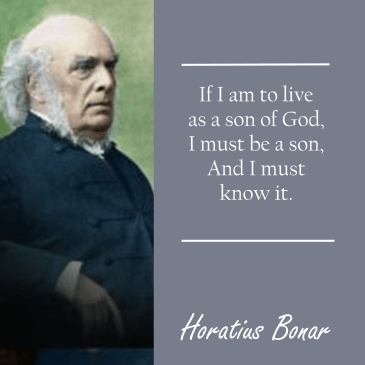
By Horatius Bonar
It is to a new life that God is calling us, not to some new steps in life, some new habits or ways or motives or prospects, but to A NEW LIFE.
To produce this new life the eternal Son of God became flesh, died, was buried, and rose again. It is not life producing life, a lower life rising into a higher, but life rooting itself in its opposite, life wrought out of death, by the death of “the Prince of life.” Of the new creation, as of the old, He is the author.
For the working out of this the Holy Spirit came down in power, entering men’s souls and dwelling there, that out of the old He might bring forth the new.
That which God calls new must be new indeed. The Bible means what it says. Of all books, the Bible is not only the most true in thought but the most accurate in speech. Great then and authentic must be that “new thing in the earth” which God “creates,” to which He calls us, and which He brings about by such stupendous means and at such a cost.
Most hateful also must that old life of ours be to Him, when, in order to abolish it, He delivers up His Son. Most dear must we be in His sight when, in order to rescue us from the old life and make us partakers of the new, He brings forth all the divine resources of love and power and wisdom to meet the critical needs of a case which would otherwise have been wholly desperate.
The man from whom the old life has gone out, and into whom the new life has come, is still the same individual. The same being that was once “under law” is now “under grace.” His features and limbs are still the same; his intellect, imagination, capacities, and responsibilities are still the same. But yet old things have passed away; all things have become new.
The old man is slain, the new man lives. It is not merely the old life retouched and made more comely: defects struck out, roughness smoothed down, graces stuck on here and there. It is not a broken column repaired, a soiled picture cleaned, an unswept temple whitewashed. It is more than all this. Otherwise God would not call it a NEW CREATION, nor would the Lord have affirmed with such awful explicitness, as He does in His conference with Nicodemus, the divine law of exclusion from and entrance into the kingdom of God
“Except a man be born again, he cannot see the Kingdom of God.” (John 3:3)
Yet how few in our day believe that “that which is born of the flesh is flesh, and that which is born of the Spirit is Spirit.” (John 3:6)
NEWNESS IN CHRIST
In Christ Jesus, God calls us
“NEW born babes” (1 Peter 2:2)
“NEW creatures” (Gal. 6:15)
A ‘NEW lump” (1 Cor. 5:7)
A ’NEW man” (Eph. 2:15)
Doers of a “NEW commandment” (1 John 2:8)
Heirs of a ‘NEW name” (Rev. 2:17)
Heirs of a “NEW city” (Rev. 3:12)
Expectants of “NEW heavens and a NEW earth (2 Peter 3:13).
This new being, having begun in a NEW birth, unfolds itself thus;
In “newness of spirit (Rom. 7:6),
According to a “new covenant” (Heb.8:8),
Walking along a “new and living way’(Heb. 10:20),
And ends in the “new song” and the “new Jerusalem” (Rev. 5:9; 21:2).
That to which we are called is no outer thing, made up of morality and good deeds, or religious rites and a routine of devotion, or religious remarks on fit occasions as to the nobleness of humanity, or the universal fatherhood of God.
It is something deeper and truer, and more genial than that which is called deep and true and genial in modern religious philosophy. Its affinities are with the things above; its sympathies are divine; it sides with God in everything. It has nothing, beyond a few expressions, in common with the superficialities and falsehoods which, under the name of religion, are current among multitudes who call Christ Lord and Master.
A Christian is one who has been “crucified with Christ,” who has died with Him, been buried with Him, risen with Him, ascended with Him, and is seated “in heavenly places” with Him (Rom. 6:3-8; Gal. 2:20; Eph. 2:5,6; Col. 3:1-3).
As such he “reckons himself dead unto sin, but alive unto God” (Rom. 6:11). As such he does not yield his members as instruments of unrighteousness unto sin, but he “yields himself unto God, as alive from the dead, and his members as instruments of righteousness unto God.” As such he “seeks the things which are above,” and sets his affection on things above, “mortifying his members which are upon the earth, fornication, uncleanness, inordinate affection, evil concupiscence and covetousness, which is idolatry” (Col. 3:5).
This newness is comprehensive, both in its exclusion of the evil and its inclusion of the good. It is summed up by the apostle in two things, “righteousness and holiness.”
“Put off…the old man, which is corrupt, according to the deceitful lusts, and be renewed in the spirit of your mind;
Put on the new man, which, after God, is created in righteousness and true holiness.” (Eph. 4:22-24) (literally “righteousness and holiness of the truth,” that is, resting on or springing out of the truth.)
The new man is meant to be righteous and holy, inwardly and outwardly, before God and man, as respects law and gospel, and this THROUGH THE TRUTH. For as that which is false (“the lie,” verse 25) can only produce unrighteousness and unholiness, so “the truth” produces righteousness and holiness, through the power of the Holy Ghost. Error injures, truth heals; error is the root of sin; truth is the root of purity and perfection.
It is then to a new standing or state, a new moral character, a new life, a new joy, a new work, a new hope, that we are called. He who thinks that faith is made up of anything less than this knows nothing yet as he ought to know. To that which man calls “piety,” less may suffice; but no religion which does not in some degree embrace these can God recognize as genuine.
These are weighty words of the apostle: “we are HIS WORKMANSHIP” (Eph. 2:10). Of Him and through Him and to Him are all things pertaining to us. Chosen, called, quickened, washed, sanctified and justified by God Himself, we are in no sense our own deliverers. The quarry out of which the marble comes is His; the marble itself is His; the digging and hewing and polishing are His: He is the sculptor and we the statue.
“We are His workmanship,” says the apostle. But this is not all. We are, he adds, “created in Christ Jesus unto good works, which God hath before ordained that we should walk in them.” The plan, the selection of the materials, the model, the workman, the workmanship, are all divine. Though it does not yet appear what we shall be, we know that we shall be “like Him”; His image reproduced in us, Himself represented by us; for we are “renewed after the image of Him that created us” (Col. 3:10)….
Called to be set apart
It is ‘to the image of His Son’ that God has “predestinated us to be conformed, that He might be the first-born among many brethren” (Rom. 8:29), having “chosen us in Him before the foundation of the world, that we should be holy and without blame before Him in love” (Eph. 1:4).
It is ‘to holiness’ that God is calling us (1 Thess. 4:7)…..
That we should have our ‘fruit unto holiness.’ (Rom. 6:22)
That our hearts should be ‘established unblameable in holiness.’ (1 Thess. 3:13)
That we should abound ‘in all holy conversation ‘and godliness.’ (2 Pet. 3:11)
That we should be ‘a holy priesthood.’ (1 Pet. 2:5)
And be ‘Holy in all manner of conversation.’ (1 Pet. 1:15)
Remembering that we are ‘called with a holy calling.’ (2 Tim. 1:9)
Presenting not our souls alone but our “bodies” as (not only a “living” but) a holy sacrifice to God (Rom. 12:1),
Remembering that these bodies are not merely ‘a sacrifice,’ but ‘a temple of the Holy Ghost” (1 Cor. 6:19).
Holiness is likeness to God, to Him who is the Holy One of Israel, to Him whom they praise in heaven as “Holy, holy, holy” (Rev. 4:8). It is likeness to Christ, to “that holy thing” which was born of the Virgin, to Him who was “holy, harmless, undefiled, separate from sinners” (Heb. 7:26).
It is not only separation from evil and from an evil world, but it is separation unto God and His service. It is priestly separation for priestly service. It is distinctiveness such as that which marked the tabernacle and all its vessels, separation from every common use. It is separation by blood, “the blood of the everlasting covenant.” This blood (or that which it signifies–death) is interposed between us and all common things, so that we are dead to sin, but alive unto God, alive to righteousness, having died and risen in Him whose blood has made us what we are: saints, holy ones.
This holiness or consecration extends to every part of our persons, fills up our being, spreads over our life, influences everything we are or do or think or speak or plan, small or great, and outward or inward, negative or positive, our loving, our hating, our sorrowing, our rejoicing, our recreations, our business, our friendships, our relationships, our silence, our speech, our reading, our writing, our going out and our coming in, our whole man in every movement of spirit, soul and body. In the house, the sanctuary, the market, the shop, at the desk, or the highway, it must be seen that ours is a consecrated life…
ROOTED IN LOVE
“Rooted in love” is the apostle’s description of a holy man.
Holiness is not austerity or gloom; these are as alien to it as levity and flippancy. Nor is it the offspring of terror, or suspense, or uncertainty, but peace, conscious peace, and this peace must be rooted in grace; it must be the consequence of our having ascertained, upon sure evidence, the forgiving love of God.
He who would lead us into holiness must “guide our feet into the way of peace” (Luke 1:79). He must show us how we, “being delivered out of the hand of our enemies,” may serve God “without fear, in holiness and righteousness before Him, all the days of our life” (v. 74,75). He who would do this must also “give us the knowledge of salvation, by the remission of sins.” He must tell us how, through “the tender mercy of our God…the dayspring from on high hath visited us, to give light to them that sit in darkness and in the shadow of death” (Luke 1:78,79).
In carrying out the great work of making us holy, God speaks to us as ‘the God of peace’ (Rom. 16:20), ‘the very God of peace’ (1 Thess. 5:23) and as being Himself ‘our peace’ (Eph. 2:14).
That which we receive from Him, as such, is not merely ‘peace with God’ ( Rom. 5:1), but ‘the peace of God’ (Phil. 4:7), the thing which the Lord calls ‘My peace,’ ‘My joy’ (John 14:27 ; 15:11 ).
KNOWING AND BELIEVING
Before I can live a Christian life, I must be a Christian. Am I such? I ought to know this. Do I know it, and in knowing it, know whose I am and whom I serve? Or is my title to the name still questionable, still a matter of anxious debate and search?
If I am to live as a son of God, I must be a son, and I must know it. Otherwise my life will be an artificial imitation, a piece of barren mechanism, performing certain excellent movements, but destitute of vital heat and force. Here many fail. They try to live like sons in order to make themselves sons, forgetting God’s simple plan for attaining sonship at once, “As many as received Him, to them gave He power to become the sons of God” (John 1:12).
A Christian is one who “has tasted that the Lord is gracious” (1 Pet. 2:3); who has been “begotten again unto a lively hope” (1 Pet. 1:3); who has been “quickened together with Christ” (Eph. 2:5); made a partaker of Christ (Heb. 3:14 ); a partaker of the divine nature (2 Pet. 1:4); who “has been delivered from this present evil world” (Gal. 1:4). Such is God’s description of one who has found his way to the cross. All that he can say for himself is that he “has known and believed the love that God hath to us” (1 John 4:16 ); and, in believing, has found that which makes him not merely a happy, but a holy man. He has discovered the fountainhead of a holy life.
By Horatius Bonar, taken fron God’s Way of Holiness in the Public Domain
 LIFE ON THE ALTAR