This article is from Issue 5, “Called To Obedience”
By A. B. Saint
The coming of Christ we know is a certainty, and in the light of this understanding revealed to us by the Holy Spirit through the Scriptures, and also by the things which are coming upon the earth, the Believer’s attitude towards Christ should cause us to live and remain in a constant attitude of fervency. A few days ago, this little word came down as it were on the wings of heaven and lodged in the good ground of my heart.
Fervency – now that’s a word to write home about! The very sound of that word cuts like a knife through mediocrity, indifference, complacency, that condition known to man as being ‘laid back.’ It cuts through the very heart of listlessness, disinterest, and the Godless state of apathy. Not so with the Believer, whose life must ever be filled with fervency.
And this little word came to me as swift and straight as an arrow flying through the air, even from within the pages of Holy Writ, for there we are led to understand that our lives must never taste of mediocrity or indifference. This is not the way forward for any child of God; this is not the path we must learn to follow.
One of the things about getting older is that it does serve a useful purpose for any saint of God in preparing us for the day which will come, when we will leave this scene of time by way of the grave, or by way of the Rapture. In view of this, the Christian’s constant attitude whilst still upon the earth must surely be one of fervency. I truly believe that as the days darken and the time grows nearer for our Lord’s Return, He will, by His Grace and through His Spirit, more than ever, highlight the necessity of this unbroken state of being in the lives of those for whom He died.
Only the other week, I was reading an article about that well-known Methodist Preacher, John Wesley. It is said that on one occasion, a lady approached Mr Wesley with this question. “Suppose you knew that you were to die at 12 o’clock tomorrow night, how would you spend the intervening time?”
Mr Wesley, taking out his pocket-book said this, “How Madam? Why, just as I intend to spend it now. I should preach this night at Gloucester, and at five again in the morning. Then I should ride to Tewkesbury and meet the Society. I should then repair to friend Martin’s house; converse and pray with the family as usual, retire to my room at ten and commend myself to my Heavenly Father, lie down to my rest and wake up in Glory.” He certainly knew something about that glorious state of fervency, didn’t he?
LUKEWARMNESS
Out of hearts of unbelief, men scoff at the thought of the wrath of God one day coming upon the world. They scoff, some of them, at the thought of His existence, they do not take Him seriously enough. The sad thing is that many in the Christian Church do not take Him seriously enough either!
The spirit of lukewarmness, for indeed it is a spirit, pervades the lives of many, and lukewarmness is not of the Spirit of God. Do you remember in Revelation 3:15, where Christ was speaking to the Church at Laodicea? He chides with them over their lukewarmness.
This is where they tell of the water supply at Colossae, how that it was cold and when poured out gave refreshing water. The water pipes at Hierapolis on the other hand, gave out hot water, which they believed contained healing properties. However, the water supply at Laodicea was drawn from the hot springs to the south and was still tepid even after flowing five miles in stone pipes.
On this note, Christ therefore says, “I would that thou wert hot or cold, but you are neither and because of this I will spue thee out of my mouth. As many as I love I rebuke and chasten, be zealous therefore and repent.”
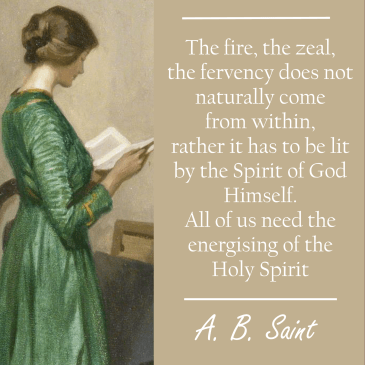
The fire, the zeal, the fervency does not naturally come from within, rather it has to be lit by the Spirit of God Himself. All of us need the energising of the Holy Spirit.
Let us look at this little word FERVENCY in more detail. What does the Bible say on this matter? Three small headings are laid out for us. The first one is that of the necessity of us being:
FERVENT IN SPIRIT
“Not slothful in business, fervent in spirit; serving the LORD.” (Romans 12:11)
Phillip’s translation puts it this way: “Let us not allow slackness to spoil our work and let us keep the fires of the spirit burning as we do our work for the Lord.” Others have it, “Be aglow with the Spirit,” or, “On fire with the Spirit.” We have to be enthusiastic souls! Many dear saints throughout history have fulfilled this brief, some we know of and others we do not. The important thing is that the Lord knows.
At this moment in time, one brother from Scripture readily comes to my mind. He is spoken of in Acts 18:24. His name is Apollos. Born at Alexandria, we are told he was an eloquent man and mighty in the Scriptures and instructed in the ways of the Lord. The Bible is quick to point out that this man was fervent in spirit, was a diligent preacher of the things of the Lord, a man who spoke boldly in the synagogue, yet his message was incomplete in that he only knew ‘the baptism of John.’
The Bible tells us he had to be lovingly taken to one side by Aquila and Priscilla who expounded unto him ‘the way of God more perfectly.’ But what a blessing that man proved to be to others as he lived his life in earnest, taking the things of God seriously and taking his daily walk seriously. He was purposeful, resolute, a man with fire in his bones, a man with a burning zeal, and Scripture remembers him for this.
FERVENT IN PRAYER
“Epaphras, who is one of you, a servant of Christ, saluteth you, always labouring fervently for you in prayers, that ye may stand perfect and complete in all the Will of God.” (Colossians 4:12)
Paul is speaking here of Epaphras, who was a faithful servant and faithful minister of the Lord. We know that at the time of writing this letter to the Church at Colossae, Epaphras was in Rome with the Apostle Paul, and from the little that is spoken of him we know that “who is one of you,” implies that he was a Colossian by birth.
From what we know of him, like Apollos, he was another brother anyone would be pleased to have join their Fellowship. This man had a good prayer life. The Word of God tells us that he laboured fervently for the Colossian Church in prayer, that they would grow on and reach a full maturity in Christ the Lord. It is recorded that he not only had a zeal for them, but for those also in Laodicea and Hierapolis.
“Labouring fervently for you in prayers,” speaks a great deal. In other words, he strove for them in prayer. Sometimes we know when translating the Greek into English, we can lose some of its meaning. However, we do know it is a word which describes an athlete who is striving to reach the finish line. He is moving at maximum output, his muscles are taut.
The word fervency comes from a verb which means ‘to stretch out the hand,’ or ‘to strain the hand.’ It paints a picture of intense effort. Now we are certainly not overly focusing on man, for God alone has the power to answer prayer, but the latter part of James 5:6 does say, “the effectual fervent prayer of a righteous man availeth much.”
Epaphras was a righteous man. Knox says, “When a just man prays fervently there is great virtue in his prayer.” Phillips has it, “Tremendous power is made available through a good man’s earnest prayer.” They both go together, the righteous and the earnest.
Now fervency in prayer is most definitely not a case of ‘who shouts loudest,’ for it is not only the tongue which prays, but also the heart. Epaphras prayed powerful prayers from the heart, in that he laboured in prayer. He prayed self-sacrificing prayers, he prayed fervently in the Will of God, and it goes without saying that he prayed in faith.
And what of Elijah? James also goes on in the bible passage to speak about him, a man characterized by an intense religious fervour. If he was not a man of zeal, then I ask you, who is? He was a man very jealous for the Lord God of Hosts, who prayed earnestly that it might not rain, and he prayed again that it would rain, and God answered prayer.
If anyone was earnestly contending for the Faith, Elijah was. These two bible characters, one from the old testament and one from the new, were kindred spirits in that they were both living godly lives, both earnest in their endeavours and both real.
FERVENCY IN LOVE
“Seeing you have purified your souls in obeying the truth through the Spirit unto unfeigned love of the brethren, see that ye love one another with a pure heart fervently.” (1 Peter 1:22)
Peter was speaking to those who had heard and had accepted the Gospel, and to those who were being obedient to its truth. The unfeigned love he refers to is a sincere love coming from believers with a pure heart. Unfeigned – not pretence. No actors or actresses involved!
The word love is mentioned twice within this verse, but the same word has a different meaning. The first love is to do with affection and friendship. It is a mutual love sometimes described as those born out of the ‘same womb.’ The second love has a different meaning, it is more to do with self-sacrificing, it is a self-sacrificing love, and it is to this second love that Peter adds the word fervency.
“Love one another with a pure heart fervently.” It is a love which is not selfish neither self-seeking, but a love which gives itself to others. In both these loves which the Apostle Peter mentions, there is a blend, a fusing, a melting together of the human and the Divine. The second love has nothing to do with feelings or emotions, it is a supernatural love. It is a love which involves the will and at times demands hard work. We have to dedicate our will to do this.
This fervency means that an intense zeal and effort is made in this area. It is a love which will always tell the truth in love. It is a fervent love which demands hard work and effort because at times this love of ours, this love which is of God, will have to be stretched out! If we did a picture study of this, we would find this fervent love is like the sound when water comes to the boil, or it is like the glow of metal when it is heated.
All of us have faults, but there are times when we will have to choose to throw a veil over each other. Now in the world most people do not do this, they uncover the faults which lie in other people, forgetting that they themselves have faults of their own.
In seeking to be fervent in love, sometimes our desire to love will be stretched out as it were like elastic. There is an elasticity about this word, an elasticity about this action. It is the going the second mile action. I looked up Thayer’s definition which said, “even to the limits of being on the rack.” It sounds undoable and in the natural it is and can only be done in the Spirit. This love for one and other is not a suggestion but rather a command.
In conclusion: How far do we stretch ourselves in service for the Lord? How far do we allow ourselves to be stretched in prayer and in love for the brethren?
My daily reading reads like this: “No man as a Christian should be found on the same spot two days together.
What are you waiting for? Is it some unseen event which is to lift you out of your deathly state and stranded position – that indefinite, undefined something, which somehow is to put all things right? Ah, do not be deceived: tidal waves do not sweep stagnant pools!”
Make haste O man to do whatever must be done; thou hast no time to lose in sloth, thy day will soon be done.
Be fervent in Spirit – Serving the Lord!
Taken from Life On The Altar Publications
Issue 5 Summer 2022
Called To Obedience

 LIFE ON THE ALTAR