This article is from Issue 6, Called to Praise
By Andrew Bonar
Praise ye the LORD:
for it is good to sing praises unto our God ;
for it is pleasant ;
and praise is comely.
(Psalm 147:1)
There are many things that might be said about praise; but you remember the Psalms have given us three statements that may guide us. The Book of Psalms says ‘Praise is PLEASANT;’ it says again, ‘It is GOOD to sing praise;’ and again it says, ‘Praise is COMELY.’
Praise is pleasant
You know it is pleasant to yourselves; but “praise is pleasant” means more than that. It means it is pleasant to GOD; it is something that God is pleased with.
Have you not noticed that though Solomon offered up that remarkable prayer in the Temple recorded in 2 Chronicles 6, yet the blessing did not come down then. It was not till a little after, when the multitude of singers were as one in giving forth their praise, and saying, “The Lord is good, and His mercy endureth for ever.” The cloud of glory came down and filled the Temple as they uttered that burst of praise.
And in the history of King Jehoshaphat going forth to battle against Ammon, Moab, and Seir, Jehoshaphat’s remarkable prayer is recorded at full length. Still, it is not then that the victory or the assurance of victory comes; but as he marched out of Jerusalem down the valley of Tekoah to where he expected to meet the enemy, they made the valley resound with songs.
It is said he consulted with the people, and instead of going forth with common martial music, they agreed they would march down the valley with the Lord’s song on their lips; and the burden of it is, “For He is good, for His mercy endureth for ever.” Now, it is added, and when the song began, ‘The Lord set an ambushment against Moab, and Ammon, and Seir,’ and Israel did not need to fight; they just came up and gathered the spoil.
See the honour God put upon true praise rendered to Himself? Prayer must ever be followed or accompanied by praise. Prayer by itself (the Lord seems to say) is very well, but He wants praise; He must have the harp as well as the golden vial full of odour.
And in the prison of Philippi what do we find? There were Paul and Silas praying. Yes, but they “sang praises,” and the emphasis is put upon the praises. It is said the prisoners heard them, or perhaps more correctly, at least more emphatically, it is, “And the prisoners were listening.” You can see them awaking, and expressing wonder to each other, and putting their ear to the door of their cell.
The prisoners were listening, for songs in a prison, songs of Zion, had never been heard there before. And it was then that the earthquake shook the prison; and the Lord came down and converted the jailer, a man memorable in the Church of God, and who will be memorable till the Lord comes. Praise is ‘pleasant’ to the Lord, as well as pleasing to us.
Praise is good
It is sanctifying. There is something in it tending to build up the soul in sanctification. How could it be otherwise? Praise is the element of heaven. If so, much of this praise must be much of heaven. What are some of the elements of heaven?
Surely one is joy – holy joy – joy in the Lord. Now, nothing sanctifies more than this joy. Mere sorrow never sanctifies; sorrow, indeed, turns us away from earthly good, but in itself the sorrow of the world worketh death.
What sanctifies? “Our light affliction, which is but for a moment, worketh for us a far more exceeding and eternal weight of glory; while we look not at the things which are seen, but at the things which are not seen” (2 Corinthians 4:17). It is joy to which we are led by sorrow that sanctifies – joy in the Lord, joy that is the element of heaven.
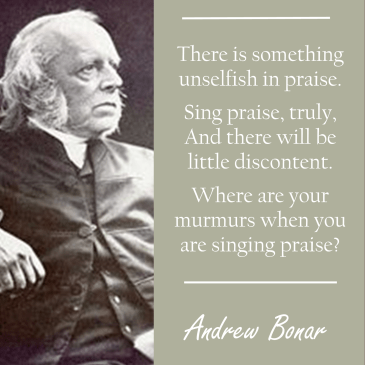
There is something unselfish in praise. You can suppose prayer to have selfishness in it, and the Lord does not object to a kind of selfishness in our prayers; that is, our seeking that we ourselves may be receivers of His blessing. But praise is more unselfish, more heaven-like, more, therefore, like Jesus; it is a giving forth of what we have received. And further, only sing praise truly, and there will be little discontent.
Is there a better remedy for discontent than praise, true praise? Where are your murmurs when you are singing praise? Oh, if those that fret and are discontented at little things, or at great things, would only substitute praise, they would soon know it is good to give thanks. Praise is sanctifying: praise chases away hard thoughts of God, which even good men often call ‘infirmities,’ but which are really downright corruption, and dishonouring to God, as much as were the murmurs in the camp of Israel.
Praise is comely
You will at once own that praise is very becoming. Whatever may be your position as a saint of God, or your position in the world, whatever may be your afflictions, or whatever your circumstances, praise is still comely. Every saint is expected in all circumstances to be able to praise continually.
Yet it is not the case that all saints always do. One of our old Scotch writers, John Livingstone, said in his day, “A line of praise is worth a page of prayer,” because he found it such a rare thing. Do you think he exaggerated? He wished to stir up believers to praise more.
And you notice in the Book of Psalms, as it gets near its close, prayer is almost forgotten; the four last psalms are a joyous burst of praise. The stream when it is just about to join the ocean is all praise, praise to God.
Let me say farther, Are you afflicted? Have you to face some special difficulty, or have you some special duty on hand? Then try praise. What did our Captain do before He went to the Mount of Olives, and as He went to the Garden of Gethsemane, the sorest of His conflicts? He sang a hymn – the Master sang a hymn with His disciples.
We are almost sure what it was; the 118th Psalm, for that was the psalm with which the Passover service was concluded; in that psalm you find this burst of praise (think of the Master singing it) : “The right hand of the Lord doeth valiantly. The right hand of the Lord is exalted: the right hand of the Lord doeth valiantly. I shall not die, but live.” Try that in going out to battle! In facing difficulties, try praise.
Taken from Life on the Altar Publication
Issue 6 Autumn 2022
Called To Praise

 LIFE ON THE ALTAR