This article is from Issue 8, Called to be Witnesses
By A. B. Simpson
“I have heard of You by the hearing of the ear:
but now my eye sees You.”
(Job 42: 5)
The book of Job is the world’s oldest poem and presents some of the profoundest spiritual teachings. The leading figure of the drama is a man who, by the testimony of God, was a good man, the best man on earth, a man who “feared God, and eschewed evil.” Yet to this man God permitted the severest tests.
WORLDY WISDOM
The first part of the scene appears in the deep inquiries of his friends and counsellors into the cause of his trial. Three philosophers and moralists came to him, sat by his side day after day, vainly trying to comfort him. They still more vainly tried to instruct him in the principles of divine government and show him that he must be guilty of some great iniquity or God would not thus afflict him.
Each of them had three turns and Job answered each three times. When it all ended, Job was utterly unsatisfied with their consolations and exhortations, and dismissed them with, “Miserable comforters are you all.” They represent the world’s best philosophy and wisdom, and prove the inadequacy of the human mind by all its searching to “find out God.”
But the trial develops. Job soon broke under his terrible continued affliction, and began to vindicate himself and reflect upon God for the injustice and severity of his affliction.
SPIRITUAL UNDERSTANDING
Then a fourth character appeared upon the scene. Elihu, whose name signifies his direct relation to God as His servant and messenger, came with an entirely new message, even with the inspired Word of God Himself. Twice he spoke and Job also answered him, but all his profound and deeply spiritual teaching fell in vain upon the ears of the tried sufferer. A stronger influence, a diviner touch was necessary before his heart would yield and his lesson be fully learned.
DIVINE REVELATION
At last it came, only through the direct revelation of God Himself when He suddenly appeared in a sublime vision of majesty and power, and spoke to him from the midst of the whirlwind.
The message was in two sections interrupted by a brief pause; Job broke down and sank in silence at God’s demand, “Shall he that contends with the Almighty instruct him? He that reproves God let him answer it.” Job replied: “Behold, I am vile; what shall I answer You? I will lay my hand upon my mouth. Once have I spoken; but I will not answer: yes, twice; but I will proceed no further.” (Job 40: 2-5.)
God proceeded through the next two chapters, unfolding to Job the majesty and glory of creation, pointing to the stars in their courses, the ordinances of heaven, the clouds and lightnings, the springs of the sea, the providence that supplies the wants of every living thing, the instincts of the birds, the mighty creatures that roam in the ocean and depths of the forest.
As the vision of God’s majesty and glory passed before Job, all his pride and self-vindication passed away, and he cried: “I have heard of You by the hearing of the ear: but now my eye sees You. Wherefore I abhor myself and repent in dust and ashes.”
This was at length the crisis of Job’s spiritual life. This was the death of self and the beginning of the life of God and from this hour the whole story turns upon its axis and the life and experience of Job becomes transformed.
THE TURNING POINT
The moment he condemned himself God began to justify him. The moment he sank in the dust God began to lift him up. The moment he ceased to contend with his friends and began to pray for them, God turned his captivity and brought them to bow at his feet and ask his forgiveness and prayers, and from that hour even his temporal circumstances were changed, his trials passed, all that was lost was restored twofold, and henceforth life flowed on upon a new plane of resurrection power, glory and blessing.
Let us look, therefore, more closely at this turning point, this crisis of a life, this great example which God has held out to us in the story of His ancient servant
HEARING OF GOD
“I have heard of You by the hearing of the ear.”
This describes the revelation which comes to the outward ear and the natural intelligence which it represents. In the book of Job, Elihu represents the revelation of God’s Word which comes to the ear and to the mind.
The revelation of God’s will and purpose is absolutely necessary and is the foundation of all deeper spiritual revelations to the soul, but at the same time, the revelation of the truth is not known without the deeper revelation of God Himself to the inner spirit by the Holy Ghost.
It requires a spiritual mind to understand the teaching of the Spirit. The cold, natural intellect cannot receive the things of God by the hearing of the ear alone. Therefore, many of the brightest and profoundest minds have failed to grasp the deeper teachings of the Scriptures and have even become enemies and mis-interpreters of the volume they have professed to explain.
Many follow Christianity having only heard of God by the hearing of the ear.
SEEING GOD
“Now my eye sees You,” he cried. It is not the truth but the God of truth. It is not the Book but its Author and Inspirer that we are now dealing with. The mission of the Holy Ghost is to reveal God through the truth and back of the truth to the earnest and inquiring soul. This was the experience that had come to Job and which broke his heart, humbled his pride, slew his self-sufficiency, and made room in his heart and life for God.
This has ever been the turning point of every great spiritual life. We are told that far off in Mesopotamia “the God of glory appeared unto . . . Abraham,” and from that moment the whole story of faith began. There was One henceforth with him whom he personally knew and in whose appearance all else became as nothing. God had appeared unto him.
Later another figure appears on the scene at a still greater crisis in the history of redemption. It is the great lawgiver, Moses. But the secret of his life is given in a single sentence: “He endured, as seeing him who is invisible.”
He had met God. He always saw Him, and the deepest cry of Moses’ heart and life was uttered later when he prayed: “I beseech You, show me Your glory.” “If Your presence go not with me, carry us not up hence. For wherein shall it be known here that I and Your people have found grace in Your sight? Is it not in that You go with us?”
The next great life that stands out in bold relief in Israel’s story is David, and the one predominant and determining feature of his life was godliness. “I have set the Lord always before me,” is the watchword of his whole experience.
Isaiah’s call came in that hour of which he says, “I saw … the Lord sitting upon a throne, high and lifted up,” and then he passed through an experience precisely the same as that of Job.
The great character of Scripture, Paul, started upon his new career from the moment he saw a vision of the Lord Jesus, and from that hour there was one Face, one Form, one Presence, one Thought that dominated his life — the vision, the presence, the will of his Master.
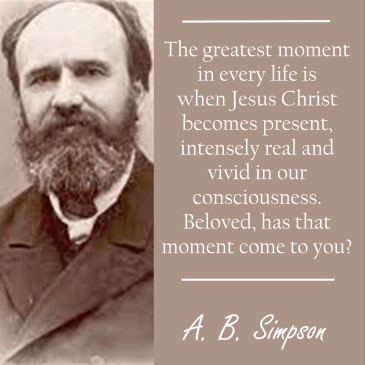
The greatest moment in every life is when Jesus Christ becomes present, intensely real and vivid in our consciousness. Beloved, has that moment come to you? Have you passed from mere intellectual knowledge of Christ to personal intimacy? Is it the historical Christ, or the Christ of today of whom you know?
THE EFFECT
The effect of the vision of God on Job was marked and immediate. It brought about the death of self. The sunburst of divine glory blinded him to every other sight, especially to the sight of himself. All his vindications, justifications, self-complacencies were gone.
In the light of God’s glory he could only see himself as worthless and utterly vile, and he longed to get out of his own sight and never see himself again. It was not merely that he took back his words and repudiated his acts, but he hated and renounced himself. Self-denial is not giving up a few things, but it is letting self go and refusing any longer to know ourselves, to live for ourselves, or to expect any good from ourselves.
This was the effect of the vision of God upon Isaiah. When he saw Jehovah in His glory he cried, “I am undone; . . . I am a man of unclean lips: my eyes have seen the King, the Lord of hosts.”
When Daniel saw this great vision he tells us, “There remained no strength in me: for my comeliness was turned in me into corruption, and I retained no strength.”
This is the only way that self can ever die; a sight of Christ, and above all, the reception of Christ to live and reign in the will, the heart, and life, will drive out every rival, especially the worst rival of all, our own will, our self-confidence, self-righteousness, and self-love.
The second effect of the revelation of God was the uplifting of his heart to divine Life. Immediately we find him praying for his enemies. If there is one miracle greater than another it is when human hate becomes transformed into heavenly love.
There is nothing so hard as to really love the people who have exasperated, tried and tormented us, and especially those that have done this like Job’s friends, in the name of religion. But the vision of God made Job equal to it. There came such a flood of divine Life and love into his soul that coloured everything henceforth with its own colour. When the heart receives Christ, it loves not as man, but as God loves.
God wants people that He can depend upon. He could say of Abraham, “I know him, that he will command his children…that the Lord may bring upon Abraham that which he hath spoken.” God can be depended upon; He wants us to be just as decided, as reliable, as stable. This is just what faith means. He is looking for those on whom He can put the weight of all His love and power and faithful promises.
A. B. Simpson
God knows that you can stand that trial; He would not give it to you if you could not. It is His trust in you that explains the trials of life, however bitter they may be. God knows our strength, and He measures it to the last inch; and a trial was never given to any man that was greater than that man’s strength, through God, to bear it.
Taken from Life on the Altar Publication
Issue 8 Spring 2023
Called to be Witnesses unto Me

 LIFE ON THE ALTAR