This article is from Issue 8, Called to be Witnesses
FROM ATHEIST TO PASTOR
“God, I know surely that You do not exist. But if perchance You exist, which I contest, it is not my duty to believe in You; it is Your duty to reveal Yourself to me.”
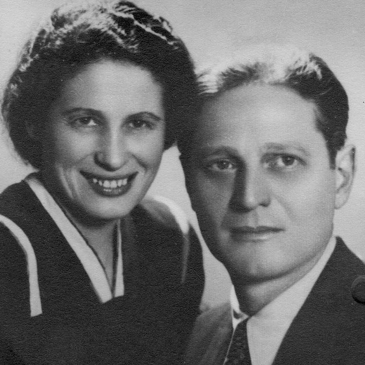
It was a sincere prayer from an intellectual and ardent Marxist, Richard Wurmbrand, a Romanian Jew born in 1909, who had been born into poverty but had gained a wealthy lifestyle as a stockbroker.
Another prayer was being asked by an aged German carpenter living in a remote village in Romania. He was poor, old and sick, and longed to bring a Jewish person to the Lord Jesus before he died, but there were none where he lived. “Lord, bring a Jew to my village and I will do my best to bring him to Christ.” Both prayers were answered in 1936 while Richard and his newly wedded wife Sabina went to the mountain village for a vacation.
A special bible was given to Richard by the old carpenter, one that had been prayed and wept over for hours. The carpenter urged the couple to at least read one of the Gospels, and as Richard read it, he came face to face with a Jewish Messiah Whose pure and perfect love cut through the hardness of his heart.
The couple were put in touch with a Jewish believer who was an evangelist supported by the Norwegian Israel Mission, who also pastored a church, and this pastor had the pleasure of seeing the two come to faith in Christ, and baptising them.
While in prayer at this church, Richard was deeply impressed upon by the Holy Spirit over Romans 12: 1. It became very clear to him that his response for receiving so great a salvation was that he should serve Christ, and that service should be a complete surrender, to be a living sacrifice.
He abandoned his carer in finance and the couple joined the Church of the Anglican Mission to the Jews, giving themselves to evangelism amongst the Jewish communities in Romania. Their efforts were greatly blessed, and the souls that were saved brought in others, and as a result a new church was formed, of which Richard was pastor. He studied and gained a formal ordination, and together Richard and Sabina worked tirelessly with others to find the lost sheep of Israel in Romania.
WW2 1939
In 1939, as Britain declared war on Germany, the couple’s first and only child was born, Michael. Romania had been neutral, but the next few years were to see the King advocate and the country become allies with Germany. A new Fascist leader turned the country into a dictatorship and the Romanian army were one with the Nazi cause.
Antisemitism was as vicious there as elsewhere in Europe, and in June 1941, Romanian Nazi soldiers, police and mobs descended on Jassy, a town with a large Jewish population, and murdered over 13,000 Jewish people. Some were shot and others were rounded up into box cars, among these were the dear Jewish Pastor who had brought Richard and Sabina to Christ.
Sabina’s parents and three siblings were killed in a concentration camp, yet despite the circumstances, the risks and the danger, the couple resolved to continue to reach out and minister in every way possible. Their Christian work was now classed as illegal, so they preached in the bomb shelters. Though arrested and beaten many times, they carried on smuggling children from the ghettos and strengthening the underground church.
RUSSIAN OCCUPATION, 1944
As war with Germany came to an end, Soviet Russia invaded Romania and the communists declared atheism to be the state religion. A million Russian soldiers occupied the country and controlled it’s government, making it part of the Eastern Europe communist bloc.
Richard now had a position that outwardly gave him good standing with authorities. He was a pastor of the Norwegian Lutheran Mission, and represented the World Council of Churches in Romania, but his real work was with the underground church, whose mission was to evangelise to all ages.
A PUBLIC STAND, 1945
Soon after, in 1945, to manipulate and control the activity and allegiance of the Church, a conference was held for all church leaders. Four thousand priests, bishops, pastors and ministers from all denominations were required to be present to declare their loyalty to the atheistic government.
At this meeting called “The Conference of Cults,” lines became blurred as one minister after another rose from their seat to announce that Christianity and communism were fundamentally the same and could coexist. Some rose and praised Stalin, and some promised their faithfulness to serve the communist government. This event was broadcasted live on radio, and the gathering of leaders raised no objections, even when told they could no longer hold Sunday school classes for the children, or engage in evangelistic activities.
As the meeting went on, many of the faithful sat in their seats stunned at the response of their fellow leaders, fearful of making a stand. Eventually, Sabina turned to Richard and said “Stand up and wash away this shame from the face of Christ! They are spitting in His face!” He turned to her and said “If I do, you will lose your husband.”
She replied, “I don’t wish to have a coward as a husband.” With that, he went to the podium on the stage and proclaimed communism as an evil, that it had made martyrs of faithful brothers and sisters. He questioned those present and listening on the radio how such a murdering system could be praised, and went on to declare his loyalty to Jesus Christ.
It changed the whole atmosphere as the grip of darkness had been challenged loud and clear. Leaders found courage and arose, standing in agreement with Richard, though others tried to shout over him. He used his opportunity, but within a short time his mic was cut and the meeting closed due to the uproar. From then on he was a marked man, but he continued the way he had on stage, unashamed and unafraid to profess Christ.
UNDERGROUND MISSION
The Communist government led many church leaders to compromise and even abandon the truth through fear. Official Churches operated under imposed limitations, and many “pastors” succumbed to the anti-God government and worked as informers for the secret police. The ban on evangelism made it dangerous work, so creative methods were employed to testify to the reality and love of Christ.
Richard was fluent in several languages, Russian being among them, and he had a deep love for the Russian soldiers who were now occupying Romania. These men had lived for decades under the rigid control of communism, yet they had a hunger for the God they had been denied knowledge of, and though they knew it was forbidden, many were desperate to hear. Every opportunity was taken.
While in a shop, Richard overheard a Russian captain with a lady officer having difficulty speaking with the shop owner, so Richard offered to translate for them. This led to him inviting the two for lunch at his home, and there, before eating, Richard said, “You are in a Christian house and we have the habit of praying.”
He prayed in Russian, and the couple responded by putting down their cutlery to feed their starving souls instead. They knew nothing of the Bible or Jesus Christ, and had so many questions from minds that had been programmed to think a certain way, but their hearts were touched by the love of Christ and they came to Him that day. They became key helpers.
Richard and others were intent on bringing those who knew only darkness into the light of Christ, and creative means were needed! They found a way to preach to groups of Russian soldiers in their barracks, who were very fond of watches and would steal them. Eventually the only place to buy a watch was at the army barracks. Romanians often went to buy back their own watch, and it became a good cover for the underground church to use.
The first time Richard went, it was the day of an Orthodox feast, the day of St Paul and St Peter. He pretended to be interested in buying a watch but declined all that were shown, and as a few more soldiers gathered round to present their watches, he asked, “Are any of you named Paul or Peter?” Some were, and so he said it was this day that St Paul and St Peter are honoured in the Orthodox Church.
He asked if anyone knew who these men were, and when they answered “no” he told them. One said “You haven’t come to buy a watch, you’ve come to tell us about the faith. Sit down and speak with us. But be careful!” The man watched for those who would oppose and said “When I put my hand on your knee, you must talk about watches, when I take my hand off, go back to your message.”
A crowd of eager listeners gathered, and the seeds bore fruit. As converts were made, word spread amongst themselves, and Richard was able to continue these Barrack visits, smuggling in thousands of secretly printed Gospels and tracts.
Another part of Richard and Sabina’s ministry was to strengthen the Romanian brethren who were sinking into poverty and despair as communism seized property livestock, and livelihoods. They did this by pointing to an exalted Jesus Who is worthy of praise and worthy of honour. Fear was making believers despondent and silent, the solution being a holy boldness that held not it’s own life dear, but was willing to die for The Christ Who had died for them.
It was dangerous work, but a few Christians would meet on a street corner and begin to sing, and when a crowd had gathered Sabina would preach a Gospel message, and they would quickly give out tracts, keeping alive the message of Jesus Christ in an environment set on stamping out God.
There were few luke-warm believers in the underground church. To be a faith filled, witnessing Christian meant that you, your family, and any who have assisted you, are under constant threat of arrest. It was costly to testify, but they had the same zeal for truth and Christ as the early church had.
Sabina often preached in the open air, knowing that bold public confession of faith was an example to bring courage and commitment to fearful believers, doubters and backsliders. The message of salvation also reached ears that were being filled with atheistic propaganda, even preaching to thousands at a factory gate before beginning their day’s work.
As well as spiritual food, thanks to financial relief that came from the Western church, she organised a soup kitchen in Bucharest that fed a thousand hungry souls a day. None of these activities were carried out without due care. Christians who were caught in evangelistic activity were severely beaten, imprisoned, even killed. Spouses were widowed, and children made orphans.
KIDNAPPED, 1948
One Sunday morning, everything was about to change. As Richard walked to church, a van of the secret police stopped by them, and four men jumped out and pushed him inside. It would be eight and a half years before he would see his family again. Richard said,
“I was kidnapped, there was no warrant of arrest. The first thing that came into my mind at that moment was, that the words ‘do not fear’ occur in the Bible 366 times, one for every day of the year, including one for a leap year. I had been kidnapped on the 29th February, on a leap year. And I said to myself, ‘What is there to fear?’ and I began to smile. My captors became frightened.
They had to interrogate me and here I was smiling, they thought I had gone mad. They asked why I smiled, and I answered “Because of the promise I have.” “What is that?” I answered that the promise I have is from Jesus, that I didn’t have to fear, and Jesus is a gentleman. He always keeps His word.
Even in the van of the secret police, I am in the hands of the Almighty, and this gave quiet to my heart.”
Sabina never heard where he was or how he was. A little time after, two men visited her posing as released prisoners with the tale that they had witnessed Richard’s death. She was told he was buried, and that she must move on with her life. She was unconvinced.
Their son, then nine years old, was himself now experiencing first hand the cost of publicly confessing Christ. Sabina was undeterred. In the midst of grief and uncertainty, she encouraged the underground pastors and leaders to continue to preach the Gospel.
HIDDEN IN CHRIST
To prevent Richard from being found, his true identity was concealed by the authorities. It worked, and for eight and a half years he passed from prison to prison registered as Prisoner 1.
Along with many others who were arrested and detained, he experienced horrific and brutal torture that came in many forms, all with the intent of breaking the will and the heart. These saints found that the way to overcome paying evil for evil was to be hidden in Christ and filled with God’s love.
“When a person has no faith in the reward of good or the punishment of evil, there is no reason to be human. There is no restraint. I learned from them. As they allowed no place for Jesus in their hearts, I decided I would not leave the smallest place for satan in mine.”
The first three years of Richard’s imprisonment was spent day and night in solitary confinement in a tiny cell. During this time he saw no daylight and heard no sound; the only man he ever saw was the one who took him from his cell to torture, torment and beat him.
He later recalled how he was so weak, starving, and worn in body and mind that he had not the strength to pray, so he simply said with all his heart, “Jesus I love You, Jesus I love You.” He was met many times in that dark cold cell with the presence of The Lord Jesus, responding to Richard’s prayer by filling him with His own love in return.
“In the ensuing years , they broke four vertebrae in my back, and many other bones. They carved me in a dozen places, and they burned and cut eighteen holes in my body. I had scars on my lungs from T. B. I should have been dead, but God is a God of miracles!”
SABINA AND MICHAEL
Just as Richard was leaving solitary confinement to be with other prisoners, Sabina was arrested and taken to a labour camp where she spent the next three years loading box cars with stones.
Their son was twelve years old and left alone in a land where it was illegal to help the families of political prisoners. But God gave courage to a willing few who in turn took him in. Surrounded by atheistic propaganda in school, the media, and the official church, Michael was vulnerable to wavering in his faith. The communist government made every effort to stamp out belief in Jesus Christ.
On one occasion he was able to visit his mother in prison, and he could scarcely recognise her as she was so frail and dirty. As soon as she saw him she shouted through the bars “Believe Jesus, believe Jesus!” It was a pivotal moment for him as he saw her fearless and unshakable loyalty and boldness with no intimidation.
He returned to school no longer able to sit quiet amidst lies that were being taught, and he now made his own stand, bravely contending for truth in the classroom, and found that other students who too had been silenced, joined him.
RELEASE, 1956
After six and a half years of being tortured and starved, he was put in an area of the prison where the sick are sent to die. This proved a very fruitful place for bringing souls into God’s Kingdom, and many came to Christ on their deathbed. He wasn’t expected to live long but he was there for two years giving hope to those closest to death.
A Christian doctor working undercover as a member of the secret police was permitted to enter the different prisons. It came as a price as all his friends shunned him, thinking he was now a communist, wearing their uniform, but he was using this cover to locate those who had disappeared.
It was in 1956, after eight and a half years of no one knowing if he was dead or alive, that this Christian doctor found Richard and brought the news to his wife and son.
During the Eisenhower-Khruschev “thaw”, millions of political prisoners were released, and thanks to the raised voices of the Christians, Richard was granted freedom.
For the next few years he and Sabina, united in every way possible, worked tirelessly together with a network of underground evangelists, spreading the Gospel, bringing hope, and strengthening believers. Financial help had started trickling through from Western churches which was used to feed poor families, and a system of underground distribution was being formed.
Unsurprisingly, Richard was arrested and spent another five and a half years in prison. Though doing so resulted in being severely beaten, he and other believers continued to preach in prison. They taught salvation through the finished work of the cross, the value of a human life, the love of God to forgive sins and our need to forgive and love our enemies.
These messages were heard by guards and officials of all ranks, and the power of God moved many hearts to see the proof of a loving God through these loving saints, who prayed with tears for their torturers. These seeds sown indeed bore a fruitful harvest among those who once declared with brutality mockery that there is no God.
Some of these guards turned to Christ and were imprisoned themselves as a result. But some were able to remain free and they advocated for Richard’s release with success.
TOGETHER AGAIN 1964
Richard was finally released in 1964 after a total of fourteen years in prison, and was re-united with his family, never to be separated by bars again. His country had changed so much, and the people were unrecognizable as the lies and propaganda had transformed the nation.
He loved his enemies, his guards, his torturers, but certainly not the father of lies, the devil, who was behind the savage regime. Now released, a new kind of battle was to begin. It was a direct assault against the lies of Communism that had spread even to the West.
A NEW MISSION 1965
Romania was accepting money to permit its citizens to leave the country, an opportunity the underground church bid Richard and Sabina take if this became available for them. They could be the voice in the West for the persecuted church, and draw attention to the realities of Communism.
The Norwegian Mission to the Jews, and the Hebrew Christian Alliance paid the Communist government a ransom of $10,000 for Richard, Sabina and their son, an amount five times the standard.
Before leaving Romania, Richard was called twice by the secret police with the warning that he could preach Christ as much as he wanted in the West, but he was not to say a word against the Romanian authorities or Communism. He was told he would be watched, but he was undeterred.
Soon after their arrival at Norway, it was arranged that Richard should travel to the US to make some speeches according to a planned itinerary, which was mainly in small military chapels. There was little response so he planned to return to Norway, but visited a Jewish Christian friend in Philadelphia first.
It just happened that during his visit, an anti-Vietnam rally was taking place, and stopping to see and hear, Richard saw that a church minister was acting as the main pro-left speaker, and so he headed straight for the microphone and got the immediate attention of the crowd by shouting “you know nothing of communism! You should be on the side of the victims instead of defending their torturers!” He took off his shirt revealing his many scars which, thanks to the press who were quick to take photos, was the image on the front page of the major newspapers in the U. S. the following day.
God had made a swift way to get the attention of hundreds of thousands of Americans in less than twenty-four hours, and the requests for interviews rushed in. Instead of heading back to Norway having not been “heard” he now stayed, and in May 1966 he testified before the U. S. Senate’s International Security Subcommittee.
He and his family were granted U.S. Immigration that year, and shortly after with an old type writer and 500 names and addresses he published the first issue of his newsletter.
Some were appalled at the details regarding the tortures he experienced, some thought he had a complex towards Communism and wished him to stick to preaching the gospel. Others were glad that he used his freedom to expose the truth of what was happening in the eastern nations, and came along side to support the underground church any way they could.
Richard and Sabina spent the remainder of their lives committed to being a voice of the persecuted church, as a result, several ministries were birthed, offices were opened in many nations in the west, eyes were opened and hearts made generous to those who were dying for their faith. Their legacy goes on today and their son continues this work.
Taken from Life on the Altar Publication
Issue 8 Spring 2023

 LIFE ON THE ALTAR