Taken from The Oil That Makes Glad by A. B. Saint
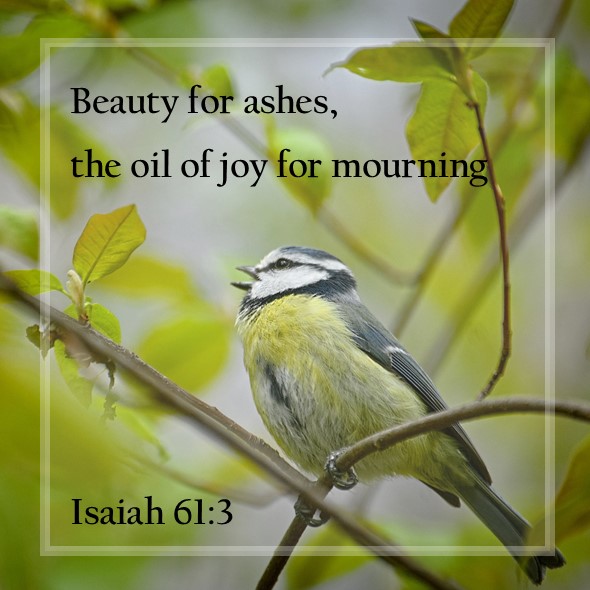
Isaiah Chapter 61 verses 1-3:
“The Spirit of the Lord God is upon me;
because the Lord hath anointed me
to preach good tidings unto the meek;
he hath sent me to bind up the broken hearted,
to proclaim liberty to the captives,
and the opening of the prison to them that are bound;
to proclaim the acceptable year of the Lord,
and the day of vengeance of our God;
to comfort all that mourn;
to appoint unto them that mourn in Zion,
to give unto them beauty for ashes,
the oil of joy for mourning,
the garment of praise for the spirit of heaviness;
that they might be called trees of righteousness,
the planting of the Lord, that he might be glorified.”
We have now come to what I think will be the last Oil for us to reflect upon in our devotional series on the Oils before us in Scripture. I have enjoyed this journey and I hope you have too. The Oil of Consolation may be the last, but it is certainly not the least in importance. Now sometimes this word can be used to describe someone or something which is seen as second best or the runner up in a competition and afterwards only receiving a consolation prize.
I well remember receiving one of these myself as a youngster in Sunday school. My parents had just recently moved to that area several months earlier, and I hadn’t been going to the Sunday School for very long and hadn’t had the chance to put the time in for either a 1st, 2nd or even 3rd prize, hence at Prize Giving I held in my small hand a thin little book, which when you opened it, on the first page had a sticker inside with my name on it along with those infamous words ‘Given as a Consolation Prize.’ Ah yes, such is life.
The Holy Scriptures of course do not intend for us to view this word in such a way but rather as being used as an expression of sympathy, of coming alongside another and offering brotherly love through moral support and commiserating with someone we know who is in need.
I am quite sure that throughout the years most of us will at one time or other have found ourselves in this situation, and it is a truly wonderful thing that in the process of doing just this, that of offering true and sincere consolation, that it also brings in its wake something known as fortification. That shoulder which we can lay our head upon or that hand which gently grips our own can be just the strengthening, just the fortifying we need.
I have an old book which I imagine will be well out of print by now, and one of its stories tells of a poor lady who had recently lost her husband around about the same time as Queen Victoria had lost her beloved Albert. The article went on to relate how that shortly after, the poor widow had a surprise knock upon her door, and who should be outside but Queen Victoria herself. The Queen was invited in, and no words were exchanged, but as they sat together the queen quietly placed her hands on the hands of the other grieving widow, and just for a few moments each of them thought not only of their own loss but the loss of the other.
Just out of interest I decided to look up the origin of the word fortification and found it comes from the Latin word Fortis meaning ‘strong’ and Facere meaning ‘to make.’ To make strong, how lovely this is. It will be true for most that when thinking of the word fortification, ancient castles will float easily into mind. These old buildings that were built with thick, high, impenetrable walls and with battlements from which they used to hide behind or shoot arrows from to keep out unwanted invaders.
What do we sometimes read on our packets of cereal? They have been ‘fortified’ with vitamins and we are told that if we eat them they will stay off the enemy of disease and will keep us safe and well. Fortification not only speaks of defence but also of strengthening something or reinforcing something. How many times in our own hour of need have we not thanked Almighty God for those He has sent along our way, who with their comfort and their consolation, have fortified, blessed, and strengthened us and helped us to carry on.
As I began to think about those verses in Isaiah chapter 61, and particularly on the Oil of joy for mourning, or as we are labelling it today, the Oil of Consolation, suddenly the Holy Spirit directed me to two other passages of Scripture. One well known the other not so well known. The first one was the tiny prophetical book of Nahum. For me this was very unusual as it is not my most cherished book, or first ‘go to’ book on my list to read, nevertheless it is an interesting little book and well worth taking a look at.
I must say at this point that if Nahum had sent me a postcard with the words, “Wish you were here,” I wouldn’t have wanted to go in spite of the fact that in its opening chapter is included that beautiful, heart-warming, little ray of sunshine verse, loved and quoted by many of us throughout the years. This is how it reads: “The Lord is good, a stronghold in the day of trouble; and He knows those who trust in Him.”
Nahum, if you remember, is known as one of the minor prophets. Minor, not because he was in any way inferior to the major prophets in Scripture, but minor in that his book consists of only three chapters. Now none of us have the privilege of choosing which time in history we would prefer to be born in and neither did Nahum, and from what I have been reading about him, if I told you that he lived in happy times I would not be telling you the truth. On the contrary, from all accounts which I have read it appears that Nahum lived during a very difficult time period in Jewish history, particularly so if he lived during the reign of the infamous king Manasseh.
What we are well aware of is that Nahum lived when it seems the cruel and barbaric Assyrians were still upon the scene. It was during this period that Nahum prophesied the fall of that great tyrannical Assyrian Empire whose headquarters were based in Nineveh. They were a cruel people in the extreme, and their barbarism knew no bounds. Over a century earlier the Lord had sent the prophet Jonah to preach the message of repentance and faith in Jehovah God to these very people.
This timely message declaring the Grace of God towards them was in full view and for a time was received, indeed the people did repent of their sins but sadly not for long, and soon they turned their backs upon the Lord and returned to their old sinful wicked ways. How sad. In point of fact, since that time they had increased even more both in size and in aggression towards other nations.
They had previously carried the northern tribes of Israel into captivity and although she was never conquered, were as a great plague to the southern kingdom of Judah, and caused them to have that fearful state of mind that a similar fate as fell upon the northern tribes might very well overtake them. Now this is interesting, if we are speaking today about comfort and consolation. Why would the Holy Spirit direct our thoughts to this obscure little prophetical book hidden, away as it were, in the old testament?
The answer is very simple, our God was sending His people a comforting message via a prophet whose name actually means Comfort or Consolation. This was no haphazard thing. God always knows what He is doing and whatever our need today, whether it be that we live in a war-torn land or are suffering the ravages of sickness within the body, whether it be the loss of a loved one and we are now experiencing the effects of loneliness, we know that as He was with Judah, so the God of all Comfort is forever with us.
Amongst the notes, quotes, and anecdotes which I have gathered together throughout the years, I have a little reading by Oswald Chambers which I once took down and have since kept. This is what he wrote on the various vicissitudes of life that often overtake us.
“Why does God allow thunderclouds and disasters when we want green pastures and still waters? Bit by bit we find, behind the clouds, the Father’s feet; behind the lightning, an abiding day that has no night, behind the thunder, a still small voice that comforts with a comfort that is unspeakable.” All this and more dear friends we find in Christ.
Now I certainly would not hanker to be a fly on the wall during the time of Nahum, but I cannot say the same thing with regards to the next and final scene which opens up to us over in the pages of the New Testament. Many times I have often contemplated this scene and wished I could have been there on that day. The scene set before us here is in the Jewish synagogue in Nazareth, and Luke the Gospel writer in chapter 4 of his book tells us it is the sabbath day, and the Lord Jesus is reading from a scroll which has been handed to Him. The text from which He is reading comes from the book of Isaiah chapter 61, the text we are contemplating on today.
It is a precious scripture and was given prophetically to the prophet Isaiah hundreds of years earlier. As our Lord begins to read, one senses a deep and thoughtful silence descending upon the room so that even the sound of the proverbial pin dropping would have been heard. The reading is given so graciously and with such a sense of command, and rightly so because the One of whom Christ is speaking is none other than Himself!
No wonder He made these verses His own because it was of Him of which the scriptures spoke! He was, on that day fulfilling the prophecy given some 700 years earlier. He was the Son of the Highest, He was the Anointed One of which the prophet spoke. If ever there was a NOW word preached for the day and age into which Jesus came, this was it.
It was unquestionably through His life that the Gospel would be preached to the poor; it was through Him that the broken-hearted and the bruised would be healed, for all who sought it there would be deliverance for each and every captive. He would in fulfilling all things bring about the recovery of sight for the blind. For sure, as we read in Luke chapter 1 and verse 79, in a spiritual sense He came to “to give light to them that sit in darkness and in the shadow of death.” Jesus sole purpose was to redeem mankind. He came to make men whole again.
At the end of the reading the Lord declared, “This day is this Scripture fulfilled in your ears.” Sadly, as we read on, although all eyes we are told were fastened upon Him, not all hearts were fixed upon Him and although His listeners might have studied Him and the things he said, yet their hearts were not stayed on Him.
Now it is noticeable that Jesus only read a portion of the prophecy given Him, He did not read it all. He only read up to where it says, ‘the Acceptable year of the Lord.’ He finished as it were with a half sentence. You see the ‘day of vengeance’ which follows in that reading is for another time. We are now still living in this wonderful Day of Grace which has been afforded us and all who will come to Christ can come, but after this present age has ended things will be very different.
It will no longer be a time of acceptance but rather vengeance which will be poured out upon all the enemies of God’s Covenant people, all the enemies of the Cross, and all the enemies of the Church of Jesus Christ.
Now, it must also be noted that another truth is to be seen here in that when Jesus was speaking of the Acceptable year of the Lord. This is sometimes known as the year of the Lord’s Favour, and Jesus was actually referring to what his hearers would understand to be the Old Testament Year of Jubilee instigated by none other than God Himself.
Very briefly, if you remember, in the 50th year a trumpet was to sound, and a declaration was to be read out. In Leviticus chapter 25 and verse 10 we read: “And you shall proclaim liberty throughout the land to all its inhabitants. It shall be a Jubilee for you: you shall return, every one of you, to your property, and every one of you to your family.”
God said this was to take place every 50 years when the land was to lie fallow and all people were to be set free from the debts they incurred. Houses and lands were to be returned to them and all captives were to be set free. The time of Jubilee heralded liberty, peace, and rest for all, and is it not true that in a spiritual sense we have all these things in Christ our Lord?
Thank God, Jesus came to those who for whatever reason were bruised or broken in heart and looked to Him for comfort. He came to make men whole again. He came to bind up and to heal. He came as an outpouring of the Oil of Consolation. As Jesus read this passage of Scripture that day, He wasn’t just speaking of the outward observance of the year of Jubilee. Rather, at His coming, He was showing that He Himself was the Jubilee personified. He was the promised Messiah for whom they were looking. He Himself was indeed the Consolation of Israel and for all those who put their trust in Him.
Let us finish our time on the Oils together by remembering these precious verses laid out for us by the Apostle Paul on the much needed life-giving ministry of comfort and consolation found in 2 Corinthians chapter 1 and verses 3 and 4:
“Blessed be God, even the Father of our Lord Jesus Christ, the Father of mercies, and the God of all comfort, who comforts us in all our tribulation, that we may be able to comfort them which are in any trouble, by the comfort wherewith we ourselves are comforted of God.”
So ends the last lesson.
 LIFE ON THE ALTAR