Taken from The Oil That Makes Glad by A. B. Saint
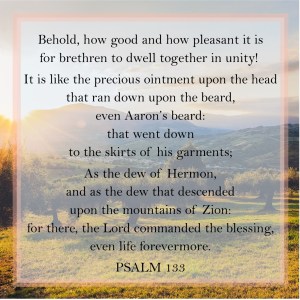
What a joyous psalm this is, comprising of only three verses, yet Psalm 133 is one of the loveliest of all the Psalms. From beginning to end these three little verses are filled with limitless, immeasurable, unbounding joy. The Psalm it seems was written by King David, a man who personally and wholeheartedly embraced heavenly things, holy things, and happy things indeed. To me the psalm paints a picture of Fellowship, Favour, Feasting and Fullness. Only recently it was this particular Psalm which the Holy Spirit brought to my remembrance in the middle of a night in which I found it difficult to sleep. During those long hours the Lord caused me to dwell upon it and in so doing it refreshed my soul and revived me. This particular Psalm is one of the 15 Psalms continuing on from Psalm 119, that are often referred to as the Psalms of Ascent, or the Songs of Degrees, or even the Pilgrim Psalms. Why these titles? In the Hebrew it is all to do with ‘going up,’ and is in reference to the various Jewish Pilgrimages that were made by the men folk at the time of the three Feasts of the Lord, which were held in Jerusalem every year. These feasts were called, the feast of Passover, the feast of Pentecost, and the feast of Tabernacles. The city of Jerusalem is built in the middle of a range of low mountains and is surrounded by seven mountain peaks higher than itself, therefore it could be seen at a distance, and each step on this steady climb would bring them nearer their destination, hence the term ‘The Ascents.’ At these times, people would converge and come together from different towns and cities where they lived, and as they did so, not only had they companionship with other likeminded people, but as they travelled onwards, they would sing these psalms, these songs of Zion together. On these occasions, they were united in heart, and mind and spirit.
What a wonderful thing unity is.
As I turned to the dictionary, I saw that the full meaning of this word refers to that state of being joined as a whole, a completeness, a concord, a harmony. If only things were like this in our world today, but sadly, in the main, for the most part, this is not the case.
During the night watches my mind was quickened in the direction of certain other Scriptures which supports or bears out the joy which can be found in that state of unity. Often in the bible we see things happening for good when there is a unity among God’s people.
For instance, take the book of Nehemiah and the re-building of the Walls of Jerusalem. Nehemiah says,
“So, we built the wall; and all the wall was joined together: for the people had a mind to work.” (Nehemiah 4:6)
This was a difficult, strenuous work which lay before them; at times the work was very challenging. The rubbish needed to be removed, the hefty stones needed to be lifted up manually and set correctly in place. Even through times of opposition the work went on, or continued, as the people learned to co-operate together. Indeed, the bible tells us ‘they had a mind to work.’ There was a spirit of unity here.
Think of that little verse in Acts 16 and verse 13 where it says,
“And on the sabbath we went out of the city by a riverside, where prayer was wont to be made, and we sat down, and spoke unto the women who resorted thither.”
By the side of this river the Scriptures tell us that the Apostle Paul preached the Gospel there, and prayers were also offered up. All those present had a desire to pray. We might think what a strange place to pray and yet at the same time, what a delightful place to pray. At a riverside, surely a place of cleansing, a place of refreshing, a place of power and a place of peace.
Why were these people not praying in the Synagogue? Evidently one had not been built there. In order to build a Synagogue, there had to be at least 10 Jewish males in attendance, whereas here there seemed to be only women. Nevertheless, thank God that He heard the prayers of these women. The riverside was a place where out in the open, prayer could still be offered up, and God would still hear each and every one of those prayers. A place where prayer ‘was wont to be made’ is a term used for a place where prayer is customary, and the place of prayer has been established.
These women came together united in the desire to seek after God. They all had the will to pray and were meeting together with the same purpose in mind, and it was in this very place where a woman known as Lydia, ‘whose heart the Lord opened,’ received further instruction in the things of the Lord, and she and her household were baptized in water.
Lastly, what about that unity and oneness which was obviously apparent in Acts 2 and verses 1-4 when it says,
“And when the Day of Pentecost was fully come, they were all with one accord in one place. And suddenly there came a sound from heaven as of a rushing mighty wind, and it filled all the house where they were sitting. And there appeared unto them cloven tongues like as of fire, and it sat upon each of them. And they were all filled with the Holy Ghost, and began to speak with other tongues, as the Spirit gave them utterance.”
The Gift of the Holy Spirit had been promised, and this was the day when the Gift of the Holy Spirit came upon them. We are told that everyone present in that Upper Room was of the same mind and the same heart, they were all in one accord and looking to the Lord. The Greek word for the word ‘accord’ is Symphonia, meaning everyone present was in perfect harmony and in total agreement. The English word ‘symphony’ comes from the Greek word “sym” which means together and “phone” which means sound.
Their hearts were in-tune with the Lord, and their hearts were in-tune with one and other. We would say today that they were all singing from the same hymn sheet! When you think about it, only God can do this with a group of people who in the natural have differing personalities and temperament types. Only He can do this.
1. THE BEARD.
At the time of the writing of this Psalm, the heart of the Psalmist seemed to overflow as he centred his thoughts on that wholesome subject of unity. His mind must have gone back to that day when Aaron, Israel’s first High Priest, long before the time in which David himself lived, was consecrated, as were his sons unto the Service of the Lord. Verses 10 to 12 of Leviticus chapter 8 tells us,
“And Moses took the anointing oil and anointed the Tabernacle and all that was therein and sanctified them. And he sprinkled thereof upon the altar seven times and anointed the altar, and all its vessels, both the laver and its foot, to sanctify them. And he poured of the anointing oil upon Aaron’s head and anointed him to sanctify him.”
The Scriptures clearly show that when Aaron was anointed for Service, the oil was not sprinkled upon him, but poured out upon him. See Leviticus chapter 21: 10, Exodus chapter 29: 7, Leviticus 8: 12.
David imagined the scene that day, and in the process he himself becomes immersed in it. Surely this is what should take place in each of our own lives as we meditate upon the Word of God. As we hold it in our hands it is no longer a dry book, but it comes to life. It is the living, breathing, Word of God. I think the same thing happens when someone is putting a sermon together, or thinking on the words of a hymn, or writing a psalm, or penning a poem maybe. As quiet contemplation takes place a picture is formed, and the scene is unveiled before us.
From afar, David watches as that sweet oil of anointing is being poured in superabundance on Aaron’s head. He watches as it runs all the way down from Aaron’s head and down onto his beard. In his mind’s eye he even sees it flowing all the way down past the folds of his garment and right on to the very edge.
Deep within David’s spirit, deep within his heart, he rejoiced to see that Holy Anointing Oil, which is a picture, a type, a shadow of the beautiful, loving Holy Spirit of God overflowing upon His people.
2. THE BRETHREN.
In verse 1 of this psalm David makes mention of the brethren, those who are the children of God and those who dwell together in that lovely spirit of unity. If only this were true of all men but sadly it is not. In the natural, often it is not in man to be united in heart and mind to his fellow man. Many, though not all, seek their own aims and hopes and ambitions, rather than seeking the best for others. How sad to have to consider this very fact even in the Church of Jesus Christ. Yes, dear friends, even in the Church.
Of course, on occasions it is quite natural for there to be differences of opinion and maybe clashes of personality, but at other times divisions begin to materialise, and cliques are formed, inner circles, which exclude others outside of the favoured few.
Hurtful words can be thoughtlessly exchanged which separate and offend. A spirit of pride or a spirit of fear can surface and spoil any unity which exists, but this ought not to be, for does God not love us all? We all know the answer; the missing piece of the jigsaw is LOVE. Did not Christ Himself preach that we should love, one and other.
A precious little memory has just floated back into my mind of a lovely Minister of the Gospel, who, when there was any build-up of tension amongst those of his church members, he would always diffuse the situation by saying, “When all else fails, try love!” Spoken in a non-judgemental way, it would usually completely disarm those in question and the situation would often be calmed.
Romans chapter 12 is a lovely chapter to read, and I particularly love J.B.Phillip’s rendering. From verse 9 onwards Paul says,
“Let us have no imitation Christian love. Let us have a genuine break from evil and a real devotion to good. Let us have real warm affection for one and other as between brothers, and a willingness to let the other man have the credit. Let us not allow slackness to spoil our work and let us keep the fires of the spirit burning, as we do our work for God.
Base your happiness on your hope in Christ. When trials come endure them patiently: steadfastly maintain the habit of prayer. Give freely to fellow Christians in want, never grudging a meal or a bed to those in want. And as for those who try to make your life a misery, bless them. Don’t curse, bless. Share the happiness of those who are happy, and the sorrow of those who are sad. Live in harmony with each other. Don’t become snobbish but take a real interest in ordinary people.
Don’t become set in your own opinions. Don’t pay back a bad turn by a bad turn, to anyone. Don’t say it doesn’t matter what people think but see that your public behaviour is above criticism. As far as your responsibility goes, live at peace with everyone.”
I think these thoughts bring us nicely to our third and final heading which is seen in the last verse.
3. THE BLESSING.
In verse 3, David illustrates this psalm with pictures of Mount Hermon and Mount Zion. I have just been reading of a man who visited this area some time ago and was interested to know his findings. He mentioned that in the hot summer months, a gentle mist would come up from the Mediterranean Sea, which would revitalise and refresh any vegetation that had been burned by the heat of the sun.
The southern hills of Judah are very dry, and he told how that when the snows begin to melt on Mount Hermon, they would descend and flow down into the valleys and the plains beneath, and everything in it’s path, both vineyard and field would celebrate its coming and experience a time of refreshing. New life was at work! He told how the plains depended upon the copious dew of Mount Hermon for their well-being.
Yet, at the same time, he pointed out that surprisingly, the valleys themselves can in turn be a blessing to Mount Hermon. In what way? In that they would disperse their own evaporations, which in turn helped prolong the snow covered peaks and the cooling winds of their giant neighbour. The lesson here is that both are needed.
Many saints of old, during their sojourn upon the earth, have well remarked upon the truth that just as the dew fell from the heights of the lofty Hermon, on to the valleys below, so it must be taken into careful consideration as we read this Pilgrim Song, that the oil, which was poured upon the High Priest, went down even to the skirts of his garment. In the whole process there is the intimation that everything comes from on high, everything is descending on what is beneath. During the long, hot, summer season, the parched ground longed for the precious dew of freshness to fall upon it in order to heal it, to refresh it and to renew it. During this process, there is the portrayal of oneness covering the land. It is a perfect illustration of everything living together in perfect harmony.
Someone has well said that unity is not uniformity, we do not have to be alike in every way to be united. We find this same lesson even in the different spices which were added to the olive oil as per God’s Divine instructions. Exodus chapter 30 and verses 22-25 informs us there was pure myrrh, sweet cinnamon, sweet calamus and cassia. It was these spices which brought out the difference in the mix.
It was this Unity, this Oneness, for which the Lord Jesus prayed in John’s Gospel chapter 17, before He went to the Cross. Coming before the Father and praying for His apostles, he said in verses 20 and 21,
“Neither pray I for these alone, but for them also which shall believe on Me through their word; that they all may be one; as Thou Father art in Me, and I in Thee, that they also may be one in us: that the world may believe that Thou hast hast sent Me.”
Here, an excellent thought is painted on the canvas of our minds, as we understand that as Mount Hermon is the highest peak in all of the Land of Palestine, so is Christ the Head of the Church. Even as Jerusalem lay within the shadow of Mount Herman, so do not the Scriptures tell us that
“He that dwelleth in the Secret Place shall abide under the Shadow of the Almighty.”
(Psalm 91: 1)
Each one of us must learn that there is no scant supply found in Christ and are therefore encouraged to stay under the flow of His Spirit’s Anointing.
Remember this:
“One star differs from another star in glory, but amid all the glories of the heavens, there is no want of unity.”
1 Corinthians (15: 41)
“As the mountains are round about Jerusalem so the Lord is round about His people from henceforth even for ever.”
(Psalm 125: 2)
With this cherished thought in mind, let us end with the chorus of a hymn which, when I sing it, usually reminds me of Psalm 133.
Chorus:
We’re marching to Zion,
Beautiful, beautiful, Zion;
We’re marching upward to Zion,
The beautiful City of God!
Isaac Watts.
 LIFE ON THE ALTAR