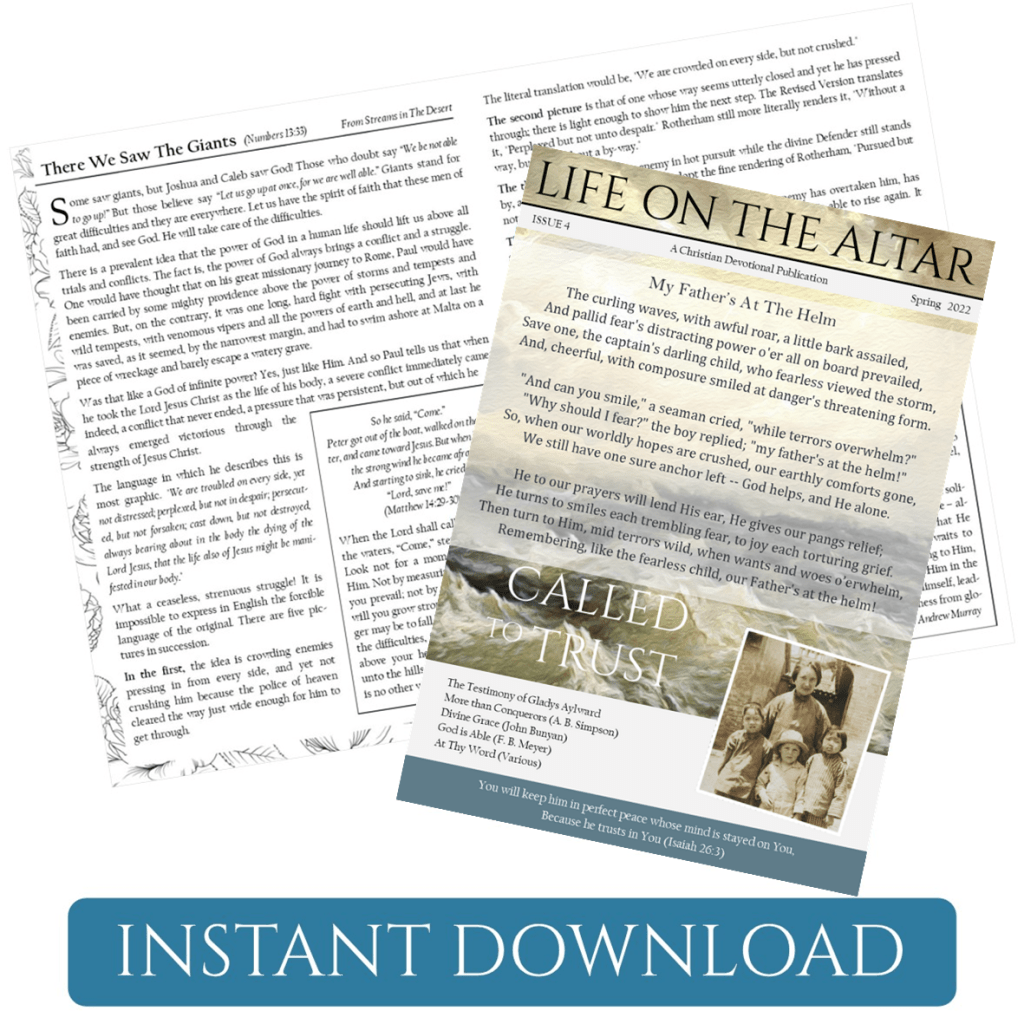
This article is from Issue 4, Called to Trust
“There we saw the giants (the descendants of Anak came from the giants); and we were like grasshoppers in our own sight, and so we were in their sight.”
(Numbers 13:33)
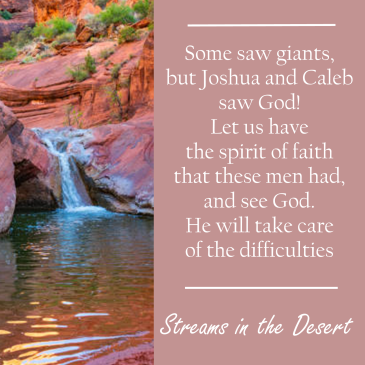
Some saw giants, but Joshua and Caleb saw God! Those who doubt say “We be not able to go up!” But those believe say “Let us go up at once, for we are well able.” Giants stand for great difficulties and they are everywhere. Let us have the spirit of faith that these men of faith had, and see God. He will take care of the difficulties.
There is a prevalent idea that the power of God in a human life should lift us above all trials and conflicts. The fact is, the power of God always brings a conflict and a struggle. One would have thought that on his great missionary journey to Rome, Paul would have been carried by some mighty providence above the power of storms and tempests and enemies. But, on the contrary, it was one long, hard fight with persecuting Jews, with wild tempests, with venomous vipers and all the powers of earth and hell, and at last he was saved, as it seemed, by the narrowest margin, and had to swim ashore at Malta on a piece of wreckage and barely escape a watery grave.
Was that like a God of infinite power? Yes, just like Him. And so Paul tells us that when he took the Lord Jesus Christ as the life of his body, a severe conflict immediately came; indeed, a conflict that never ended, a pressure that was persistent, but out of which he always emerged victorious through the strength of Jesus Christ.
The language in which he describes this is most graphic. “We are troubled on every side, yet not distressed; perplexed, but not in despair; persecuted, but not forsaken; cast down, but not destroyed, always bearing about in the body the dying of the Lord Jesus, that the life also of Jesus might be manifested in our body.”
What a ceaseless, strenuous struggle! It is impossible to express in English the forcible language of the original. There are five pictures in succession.
In the first, the idea is crowding enemies pressing in from every side, and yet not crushing him because the police of heaven cleared the way just wide enough for him to get through.
The literal translation would be, “We are crowded on every side, but not crushed.”
The second picture is that of one whose way seems utterly closed and yet he has pressed through; there is light enough to show him the next step. The Revised Version translates it, “Perplexed but not unto despair.” Rotherham still more literally renders it, “Without a way, but not without a by-way.”
The third figure is that of an enemy in hot pursuit while the divine Defender still stands by, and he is not left alone. Again we adopt the fine rendering of Rotherham, “Pursued but not abandoned.”
The fourth figure is still more vivid and dramatic. The enemy has overtaken him, has struck him, has knocked him down. But it is not a fatal blow; he is able to rise again. It might be translated, “Overthrown but not overcome.”
Once more the figure advances, and now it seems to be even death itself, “Always bearing about in the body the dying of the Lord Jesus.” But he does not die, for “the life also of Jesus” now comes to his aid and he lives in the life of another until his life work is done.
So he said, “Come.” Peter got out of the boat, walked on the water, and came toward Jesus.
But when he saw the strong wind he became afraid. And starting to sink, he cried out, “Lord, save me!”
(Matthew 14:29-30)
When the Lord shall call to you over the waters, “Come,” step gladly forth. Look not for a moment away from Him. Not by measuring the waves can you prevail; not by gauging the wind will you grow strong; to scan the danger may be to fall before it; to pause at the difficulties, is to have them break above your head. Lift up your eyes unto the hills, and go forward—there is no other way.
Taken from Streams in The Desert
Taken from Life On The Altar Publications
Issue 4 Spring 2022
Called To Trust
 LIFE ON THE ALTAR